
AUTHORITY EXPOSURE BRIEFING
Tell us the shape of your environment. We'll show you what your authority model looks like.
Five questions, about two minutes. No data, no credentials, no system access. Just the shape.
We build a model the same shape as yours, then walk you through it in 30 minutes and name three authority exposure questions your current governance stack probably cannot answer.
What happens next
-
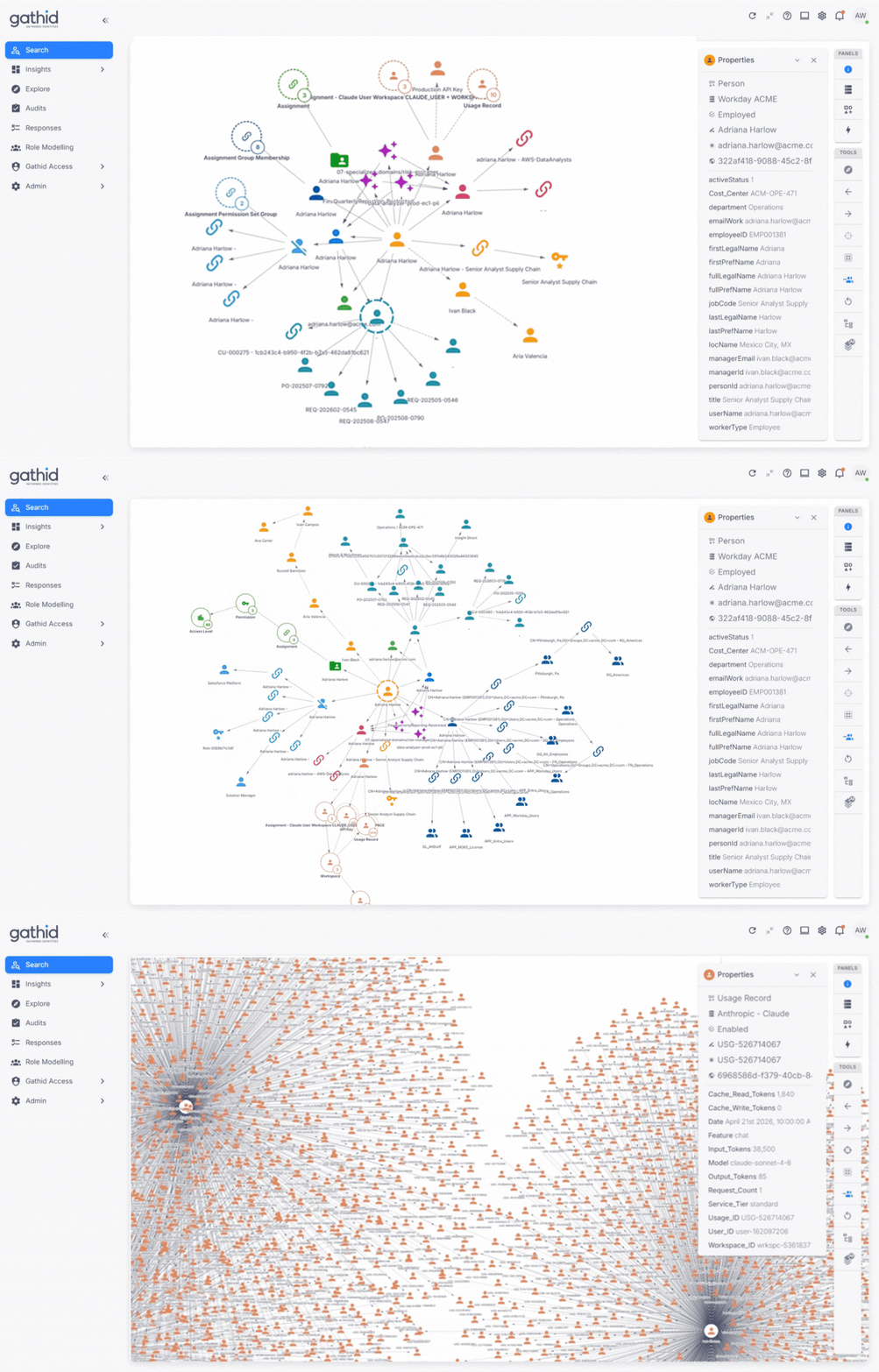
A replica authority map is being generated, modelling a similar shape to your own, using generated data.
-
Your link will typically arrive within 48 hours. This duration will depend on the size and complexity of what you have described, we will keep you posted along the way and come back to you if we have questions.
-
Followed by a 30 minute calendar invite with someone who can walk you through it.
-
Nothing connects to your systems, and nothing you tell us here is data.
Peace of mind
We do not use your data to train our models. We use it to shape what you see. Gathid is built on more the two decades of complex identity programs, none of that training happens with your data or on this page.
What we are not asking for. No credentials, no exports, no account names, no counts from your real environment. The briefing runs on generated data shaped like your estate. If a question here would require you to reveal something confidential, skip it.

What the Gathid Authority Map is
The Gathid Authority Map is a model of the relationships between identities, accounts, roles, credentials, systems and owners across everything in scope. Not a list of entitlements per platform. The relationships themselves, held as relationships, so that a question which crosses several of them can be answered by asking rather than by investigating.
It is rebuilt from source data rather than patched from events, which is what makes drift visible: the difference between one rebuild and the next is the measurable form of authority accumulating.
What it produces is not a findings list. It is a structure you can interrogate, reproduce and defend, where the same query returns the same answer for anyone who runs it.
The current page answers "What is Gathid?" with a graph database and a digital twin rebuilt every 24 hours. All true, and all mechanism. A reader who does not already know what authority modeling is learns how it is built without learning what it is for. The mechanism keeps its place on the page, further down.
What it models
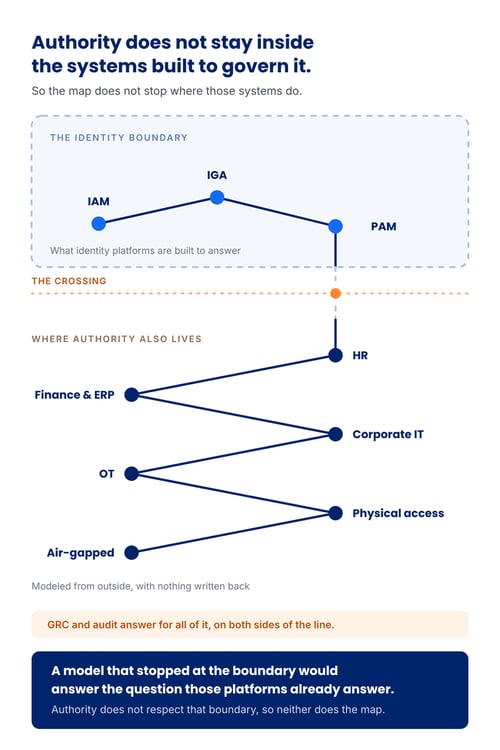
Authority does not stay inside the systems built to govern it.
If the model only covered identity platforms, it would answer the same question those platforms already answer, in the same boundary. Authority does not respect that boundary, so neither does the map.
What becomes answerable
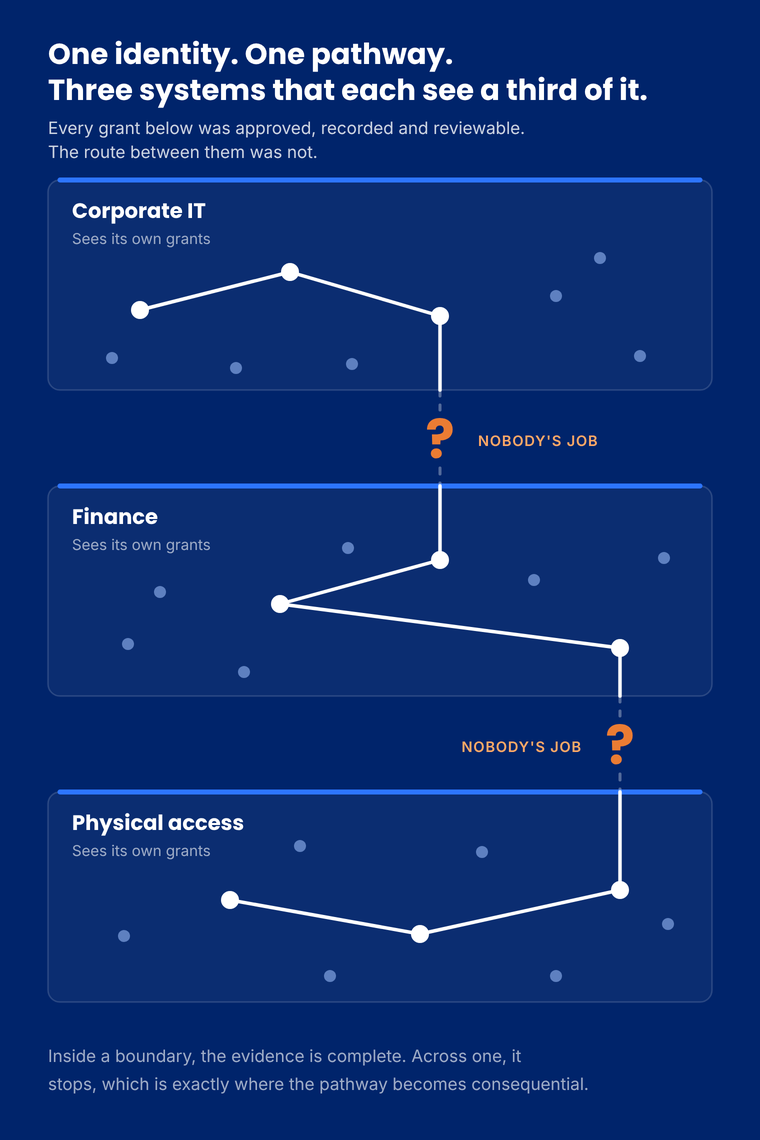
Questions that currently take a project, answered as a query.
Theee are five shapes every authority question takes.
Whether your organization can answer them quickly, from current data, without a manual investigation, is itself the finding.
How it Works
Read from the source, rebuilt daily, written back to nothing.
It reads. Gathid takes data from the systems in scope and builds the model outside them. Nothing is written back into a source system, and nothing has to change inside one for the model to exist.
It rebuilds rather than patches. The model is reconstructed from complete source data rather than updated from events, which is what keeps it current and what makes drift between rebuilds measurable instead of assumed.
It holds relationships as relationships. A multi-hop question is answered by traversing the model, which is why reachability is a query here and an investigation elsewhere.
It leaves the action to people and systems. Gathid reasons about authority and shows what it finds. It does not provision, revoke, approve or enforce anything without an action. Where a finding warrants action, it reaches whoever already owns that decision, as a notification or a ticket in the system they already work in, with the pathway and the evidence attached. The change is made by them, in the system that governs it. The model reasons. Your people decide.

Before Gathid, managing identity access felt like a maze. Now, it's streamlined and secure. A game-changer for our cybersecurity."
The Power of Gathered Intelligence
Inspired by the power of gathered identities, Gathid pinpoints identity and access anomalies, symbolized by our iconic blue dot. This isn’t just pattern recognition; it’s 20 years of expertise in distinguishing critical insights from the noise to ensure the integrity and security of your identity information across your systems.
Why Choose Us

Expertise & Experience
Gathid stands out with over two decades of industry leadership, offering unrivaled insights and proven solutions across complex identity landscapes.

Proactive Approach
Gathid helps anticipate and mitigate identity threats before they arise, ensuring your digital ecosystem remains resilient against emerging challenges.

Scalable
Solution
Our scalable solution adapts to your growing needs, ensuring seamless integration and performance regardless of your organization’s size.

End-to-End
Support
From initial consultation to ongoing utilization, Gathid provides comprehensive support, ensuring your identity governance framework thrives.
We partner with forward-thinking companies in sectors like mining, manufacturing and banking (spanning 1,000 to 100,000 employees) who put a premium on cutting-edge technology and ironclad security.
Frequently Asked Questions
What is the difference between access and authority?
Access is what a system granted, recorded in that system. Authority is what those grants add up to once inheritance, delegation and the relationships between systems are resolved. The first is written down. The second is not, which is why it goes ungoverned.
Does Gathid replace our existing platforms?
No. It models authority across them and sits entirely outside them, so nothing is replaced and nothing has to change. Your identity, privileged access and governance platforms keep doing what they do, with a complete picture of authority to act on.
Does Gathid write to our systems?
Not without an Action in place.
It reads from the systems in scope and never writes back into them. Where a finding needs action, it raises a notification or a ticket in the service management system you already use, and an accountable person carries out the change through your own process.
What does it connect to?
Corporate IT, operational technology, physical access and video, air-gapped environments, identity and privileged access platforms, governance tooling, and the non-human identities and agents running across all of them.
How long before it is useful?
The model is built from the data you already hold, so the first answers come from the first build rather than from a program of integration work. What takes time is deciding what to do about what it shows.
Who decides what happens next?
You do. Gathid surfaces the structure and the conclusion. Interpretation, prioritization and the decision to act stay with your people, and every change remains attributable to the person who approved it.
Book a Business Authority Exposure Briefing