
CISO
Your controls are passing. That is not the question you will be asked
Reviews complete, attestations close, and maturity scores improve. None of them state what a single misused identity could set in motion across your estate today. The Gathid Authority Map answers that question from current data.
The question behind the question
Security programs are measured on control completion because control completion is measurable. The exposure question is different in kind. It is not whether a review was performed, but what the granted authority actually makes possible once inheritance, delegation, service identities, and cross-system relationships are resolved. That question is structural, and a process cannot answer it. Only a model can.


Why the gap persists
Every platform in a modern identity stack answers part of the problem well. Identity providers authenticate. Provisioning platforms grant. Governance tools review. Privileged access controls contain. Detection tools alert. None of them model the relationships between identities, roles, credentials, systems, and assets, so none of them can state who actually holds authority across the enterprise today.
-
Reviews confirm intent was approved, not what the approval created
-
Point-in-time exports age immediately and silently
-
Multi-hop questions become manual investigations rather than queries
-
Structural risk is discovered after an incident rather than before one
What the Gathid Authority Map shows
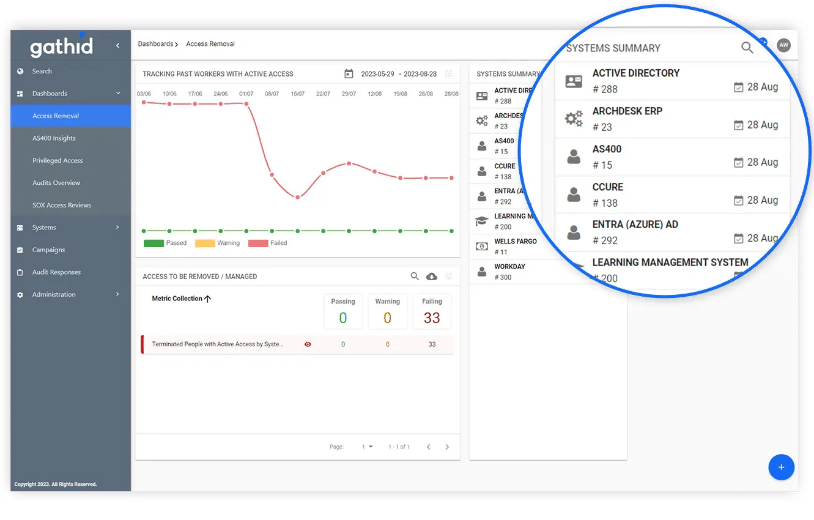
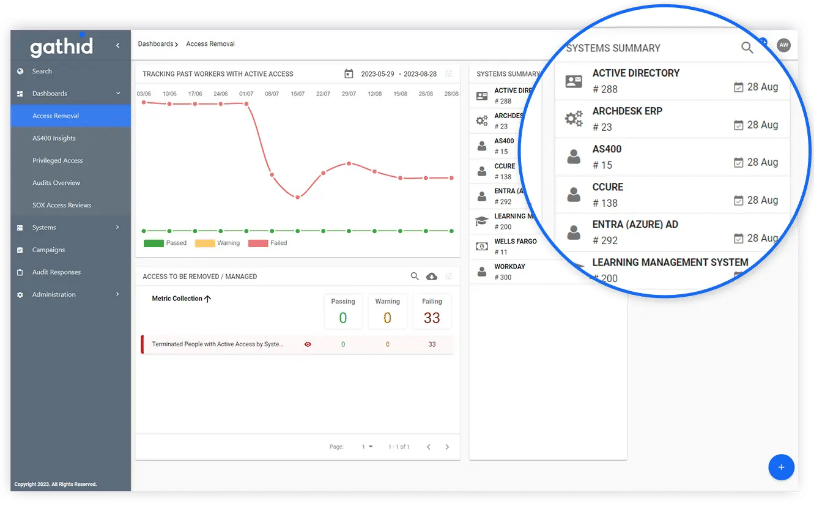
A continuously maintained, queryable model of enterprise authority across the systems in scope, rebuilt from complete source data rather than patched from events.
-
Blast radius for a named identity, account, or credential, computed rather than estimated
-
Authority pathways and hidden escalation routes across systems
-
Authority concentration, showing where a breach would be most consequential
-
Authority drift between rebuilds, so accumulation is visible rather than assumed
-
Evidence you can put in front of a board, an auditor, or a regulator without caveat

What changes in practice
-
Remediation prioritized by structural consequence instead of finding count
-
Investment defended on exposure reduced, not process completed
-
Automation sequenced after authority is understood, which is the order that keeps it safe
-
A credible answer to the board question that follows every incident: how did we not know
How Gathid fits your stack
Alongside your stack, not instead of it. Gathid works with the IAM, IGA and PAM platforms you have already invested in, making the controls you own more precise.
Understand, measure, control. Authority structures you can see, quantify and change deliberately, rather than discover during an incident.
Connected to where the work happens. The Gathid Authority Map is reachable through the API and a permission-scoped MCP server, and raises notifications and tickets in the systems your team already works in, so insight reaches the people who act on it.
Attributable by design. The model reasons, your people decide. Every change stays traceable to the person who approved it, which is what makes connecting an authority model defensible to a board and an auditor.
Book a Business Authority Exposure Briefing
Before Gathid, managing identity access felt like a maze. Now, it's streamlined and secure. A game-changer for our cybersecurity."
The Power of Gathered Intelligence
Inspired by the power of gathered identities, Gathid pinpoints identity and access anomalies, symbolized by our iconic blue dot. This isn’t just pattern recognition; it’s 20 years of expertise in distinguishing critical insights from the noise to ensure the integrity and security of your identity information across your systems.
Why Choose Us

Expertise & Experience
Gathid stands out with over two decades of industry leadership, offering unrivaled insights and proven solutions across complex identity landscapes.

Proactive Approach
Gathid helps anticipate and mitigate identity threats before they arise, ensuring your digital ecosystem remains resilient against emerging challenges.

Scalable
Solution
Our scalable solution adapts to your growing needs, ensuring seamless integration and performance regardless of your organization’s size.

End-to-End
Support
From initial consultation to ongoing utilization, Gathid provides comprehensive support, ensuring your identity governance framework thrives.
We partner with forward-thinking companies in sectors like mining, manufacturing and banking (spanning 1,000 to 100,000 employees) who put a premium on cutting-edge technology and ironclad security.
Frequently Asked Questions
What is Enterprise Authority Assurance?
It is knowing, at any moment, what any identity, account or credential in your estate could actually set in motion if it were misused, and being able to prove it. Control completion tells you a review was performed, an attestation closed or a maturity score moved. Authority assurance answers a different question: what the granted authority makes possible once inheritance, delegation, service identities and cross-system relationships are resolved. That question is structural, and it is answered by a model rather than by a process.
Isn’t this what my IGA, PAM or CIEM platform already does?
Each of those answers part of the problem well, inside its own boundary. Governance tools review what was requested and approved. Privileged access tools contain the accounts you have told them are privileged. Cloud entitlement tools analyze permissions within a provider. None of them model the relationships between identities, roles, credentials, systems and assets across the whole estate, which is why multi-hop questions become manual investigations. Gathid sits alongside those platforms and supplies the complete picture of authority they lack individually.
What does “blast radius” mean here, and how is it different from what I estimate today?
Blast radius is the full set of actions a named identity could take across the estate if it were misused, after every pathway is followed to its end. Most programs estimate it from role descriptions and privileged account lists. Gathid computes it from current data, which includes the routes nobody listed: the nested group, the delegation set up years ago, the service account that connects two systems, the escalation path that only exists once three individually reasonable grants are combined.
What do I put in front of the board?
A small number of structural measures that move: how many identities could do serious damage if compromised, how much authority is concentrated in them, how many hold reach with no accountable owner, and how those numbers changed since the last rebuild. Those are measures of exposure rather than effort, and a board can follow them quarter to quarter without a security background. Finding counts and review completion rates show the team is busy. Structural measures show whether risk is going down.
Can I use the findings from Gathid as evidence with auditors and regulators?
Yes. Because the map is rebuilt from complete source data rather than sampled extracts, and every change is attributable to the person who approved it, the evidence holds under follow-up questions, which is where estimates and point-in-time exports usually fail.
How does Gathid handle non-human identities?
As first-class identities with authority and, frequently, no owner. Service accounts, integrations, workload identities and AI agents now hold a large share of authority in most estates and sit outside most review processes. The map shows what each one can reach, which systems it connects and who is accountable for it, which is usually where the first consequential findings appear.
The Power of Gathered Intelligence